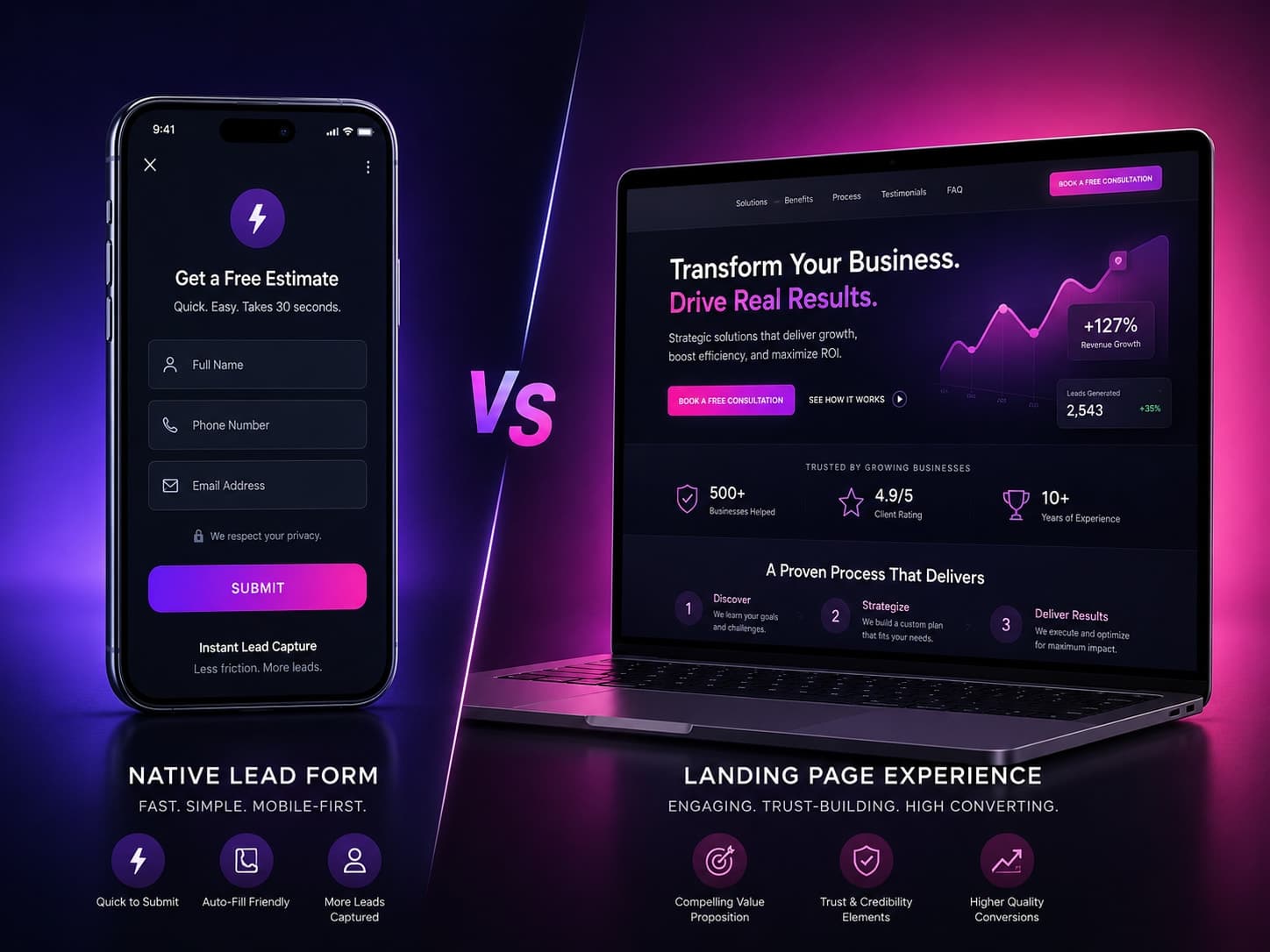
Small businesses often ask a simple question before running Meta Ads: should we use Facebook lead forms or send people to a landing page?
The honest answer is that both can work, but they solve different problems.
Meta instant forms are built for speed. People can submit their details inside Facebook or Instagram without leaving the app. Landing pages add an extra step. That extra step can lower lead volume, but it can also filter out people who were never serious.
If you only care about cost per lead, instant forms often look attractive. If you care about booked calls, qualified enquiries, and revenue, the answer is more complicated.
This guide breaks down when to use each option, how to judge lead quality, and how small businesses can stop wasting money on leads that never become conversations.
What Meta lead forms are
Meta lead ads with instant forms let people submit information directly inside Facebook or Instagram. According to Meta's own help documentation, advertisers can choose instant forms as the conversion location when using the Leads objective. The form can collect contact details and can include custom questions, conditional answers, conditional logic, gated content, and a privacy policy link.
The biggest benefit is convenience. The user does not need to wait for a website to load. Their name, email, or phone number may already be prefilled by Meta. That makes submission fast.
That speed is also the risk.
When something is this easy to submit, you may collect more low-intent leads. Some people tap quickly, forget they submitted, or are not ready to speak to sales.
What landing pages are better at
A landing page sends the user from the ad to a dedicated page on your website. The page explains the offer, answers objections, shows proof, and asks the person to complete a form or book a call.
This adds friction, but not all friction is bad.
For higher-ticket services, a landing page can help the prospect understand the price range, process, results, and next step before they contact you. That can reduce wasted sales calls.
A landing page also gives you more control over:
- Brand presentation
- Tracking and analytics
- Case studies and proof
- FAQs and objection handling
- Form design
- Conversion testing
- Retargeting audiences
For a business selling web design, home renovation, legal services, coaching, B2B consulting, or medical aesthetics, the quality of the conversation matters more than the raw number of leads.
What the data says
A WordStream analysis of Facebook Lead Ads versus landing pages found that lead ads converted clicks into leads at a higher rate in the accounts they reviewed: an average conversion rate of 12.54 percent, compared with 10.47 percent for landing page conversion campaigns.
But their own account analysis showed landing pages producing better downstream quality. Conversion campaigns produced a higher qualified lead rate and a higher demo conversion rate.
That is the pattern many advertisers see in practice.
Lead forms can produce more leads. Landing pages can produce more serious leads.
The right choice depends on your offer, follow-up process, sales team, and budget.
When Meta lead forms make sense
Use instant forms when speed and volume matter.
They are useful for:
- Simple offers
- Low-friction enquiries
- Event registrations
- Newsletter signups
- Free downloads
- First-stage lead capture
- Businesses with fast phone or WhatsApp follow-up
- Retargeting warm audiences
Lead forms can also work well when you add qualifying questions. Do not only ask for name, phone, and email. Ask one or two questions that help your team understand whether the person is a real fit.
Examples:
- What service are you interested in?
- When do you want to start?
- What is your approximate budget?
- Which location do you need help in?
- Are you the decision-maker?
Keep the form short, but do not make it so easy that every casual click becomes a lead.
When landing pages make more sense
Use landing pages when the buyer needs more context before converting.
They are usually better for:
- Higher-ticket services
- B2B offers
- Complex services
- App or software demos
- Web design and marketing packages
- Medical, legal, real estate, and finance offers
- Offers where trust and proof affect the sale
A landing page gives you space to explain why someone should choose you. It can show previous work, testimonials, pricing guidance, process, expected timelines, and FAQs.
That extra information can stop your sales team from wasting time with people who did not understand the offer.
The hidden problem: follow-up speed
Many businesses compare lead forms and landing pages while ignoring the biggest leak: slow follow-up.
If a lead comes in and nobody responds for hours, the campaign will look worse than it really is.
Small businesses should aim to respond within minutes, not the next day. The first response can be a WhatsApp message, email, call, or automated confirmation, but it should happen fast.
A simple follow-up system should include:
- Instant CRM capture
- Sales team notification
- WhatsApp or SMS confirmation
- Clear lead source tagging
- A task for the assigned salesperson
- A backup reminder if nobody responds
Without this, both lead forms and landing pages can fail.
The metric that matters: cost per qualified lead
Cost per lead is useful, but it is not enough.
A campaign can generate 200 cheap leads and still lose money if only 3 are serious. Another campaign can generate 40 expensive leads and win if 12 book calls and 4 become customers.
Track these numbers instead:
- Cost per lead
- Contact rate
- Qualified lead rate
- Booked call rate
- Show-up rate
- Close rate
- Revenue per lead source
This changes the conversation from "Which campaign is cheaper?" to "Which campaign produces customers?"
That is the conversation business owners actually need.
A practical decision framework
Choose Meta lead forms if:
- You need volume.
- Your offer is simple.
- Your team follows up fast.
- You can qualify inside the form.
- You are testing audience interest.
- You want to build retargeting lists.
Choose landing pages if:
- Your service is expensive or complex.
- The prospect needs proof before enquiring.
- You want better analytics.
- Your website loads fast.
- You need strong brand positioning.
- Your sales team is tired of weak leads.
Use both if:
- You have enough budget to test properly.
- You can compare quality in your CRM.
- You want lead forms for top-of-funnel capture and landing pages for high-intent offers.
How to improve lead forms
If you use lead forms, set them up properly.
Use the higher-intent form option where relevant. Add a short intro that explains the offer clearly. Ask one or two qualifying questions. Use conditional logic if different answers need different next steps. Add a clear privacy policy. On the thank-you screen, tell people exactly what happens next.
Do not leave leads sitting in Meta. Connect the form to your CRM, email, WhatsApp workflow, or sales notification system.
How to improve landing pages
If you send traffic to a landing page, the page must be built for conversion.
A strong landing page should include:
- A clear headline tied to the ad promise
- One main offer
- Short sections that answer buyer questions
- Social proof or examples of work
- A visible form or booking CTA
- Fast mobile loading
- Clear tracking through Meta Pixel and conversion events
The page should not be a generic homepage. Homepages have too many paths. Campaign traffic needs a focused page.
Nuru Digital's recommendation
For most small businesses, the best approach is not a permanent rule. It is a test.
Start with the business goal.
If you need quick enquiry volume and have strong follow-up, test Meta lead forms. If you sell a considered service and need better quality, build a focused landing page.
If budget allows, run both with the same offer and judge them by cost per qualified lead, not cost per lead.
The winning campaign is the one that creates real sales conversations at a profitable cost.
Frequently Asked Questions
Are Facebook lead forms better than landing pages?
They are better for speed and volume. Landing pages are often better when the buyer needs more information before becoming a serious lead.
Do Meta lead forms produce low-quality leads?
They can, especially if the form only asks for basic contact details. Quality improves when you use higher-intent settings, qualifying questions, and fast follow-up.
Are landing pages more expensive?
They can cost more upfront because you need copy, design, tracking, and testing. But they may reduce wasted sales time if they attract better-qualified enquiries.
Should small businesses use both?
Yes, if budget allows. Testing both gives you real data on lead volume, qualification rate, booked calls, and sales.
What should I track after a lead comes in?
Track contact rate, qualification rate, booked calls, show-up rate, close rate, and revenue by campaign source.
Conclusion
Meta lead forms and landing pages are both useful. The mistake is treating either one as magic.
Lead forms reduce friction. Landing pages add context. Your job is to choose the path that matches your offer, sales process, and follow-up capacity.
If you only measure cost per lead, you may reward the wrong campaign. Measure the full path from click to qualified conversation to sale.

Nuru Digital is a performance marketing agency serving ambitious brands across MENA and Africa. We specialise in Meta Ads, Google Ads, SEO, and high-converting web design.